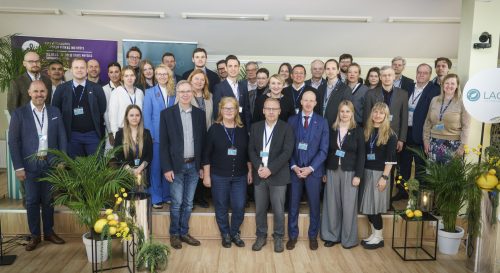
On 4 November, the second Steering Committee meeting of the Swiss–Latvian cooperation programme “Stronger VET for the Enhancement of Vocational Education and Training in Latvia” took place at the Ministry of Education and Science of Latvia. Latvian and Swiss partners reviewed progress to date, discussed key challenges and reaffirmed the importance of continued cooperation to ensure that vocational education and training (VET) in Latvia becomes more closely aligned with labour market needs.
The meeting focused on developing an industry-based vocational education model, improving professional qualification examinations, introducing digital learning solutions and developing a new training programme for vocational education teachers.
Initial results already achieved
One of the most significant achievements to date has been the piloting of a new approach to organising professional qualification examinations, with greater involvement of industry representatives.
A total of 125 students have already participated in professional qualification examinations for agricultural mechanisation technicians and heavy vehicle mechanics. This experience is helping to assess how industry organisations can take on a greater role in evaluating professional skills and how the approach could be introduced more widely in the future.
Work is also continuing on the development of an industry-based vocational education model. In cooperation with industry experts, the principles for organising training and the responsibilities of companies and educational institutions are being refined, while potential funding arrangements are being assessed.
First pilot projects planned for 2027
The next major step in the Swiss–Latvian Cooperation Programme will be to test the proposed education model in practice. Starting in 2027, the industry-based vocational education model is expected to be gradually piloted in four sectors: agriculture, mechanical engineering, energy and hospitality.
The pilot projects are expected to cover six vocational qualifications, involving vocational education institutions and companies across different regions of Latvia. Discussions with industry representatives on the specific conditions for implementation are still ongoing.
At the same time, efforts are being made to create a more modern learning environment. With support from the project, digital learning resources and simulation equipment are planned to be introduced into vocational education programmes by 2029, enabling students to acquire and further develop professional skills using technologies relevant to their respective industries.
New opportunities for prospective and current vocational education teachers
The meeting also addressed the training of vocational education teachers. An important step has been taken in this area, with the University of Latvia selected to develop and implement a new teacher qualification programme in cooperation with the Swiss Federal University for Vocational Education and Training.
The new continuing vocational education programme will enable industry professionals to become teachers and help existing vocational education teachers obtain the necessary teaching qualifications.
The programme is planned to offer flexible learning arrangements, combining theoretical knowledge with practical experience in vocational education institutions and companies. The first participants are expected to enrol in autumn 2027, with plans to train up to 100 qualified vocational education teachers by August 2029.
In addition to the new programme, professional development activities are planned for practising vocational education teachers and in-company trainers, alongside the development of digital teaching resources and a digital handbook.
Cooperation as the foundation for future development
The meeting brought together representatives of the Ministry of Education and Science, the Ministry of Finance, the State Education Development Agency, the Embassy of Switzerland in Riga, Swiss cooperation partners and industry associations involved in the project.
Participants emphasised the importance of close cooperation between public authorities, educational institutions and employers. Active industry involvement is essential to ensuring that the new approaches respond to actual labour market needs and deliver long-term benefits for both students and companies.
The project will continue until 2029. During its next implementation phase, the focus will be on putting the proposed solutions into practice, strengthening cooperation and exchanging experience with Swiss partners.





 Back